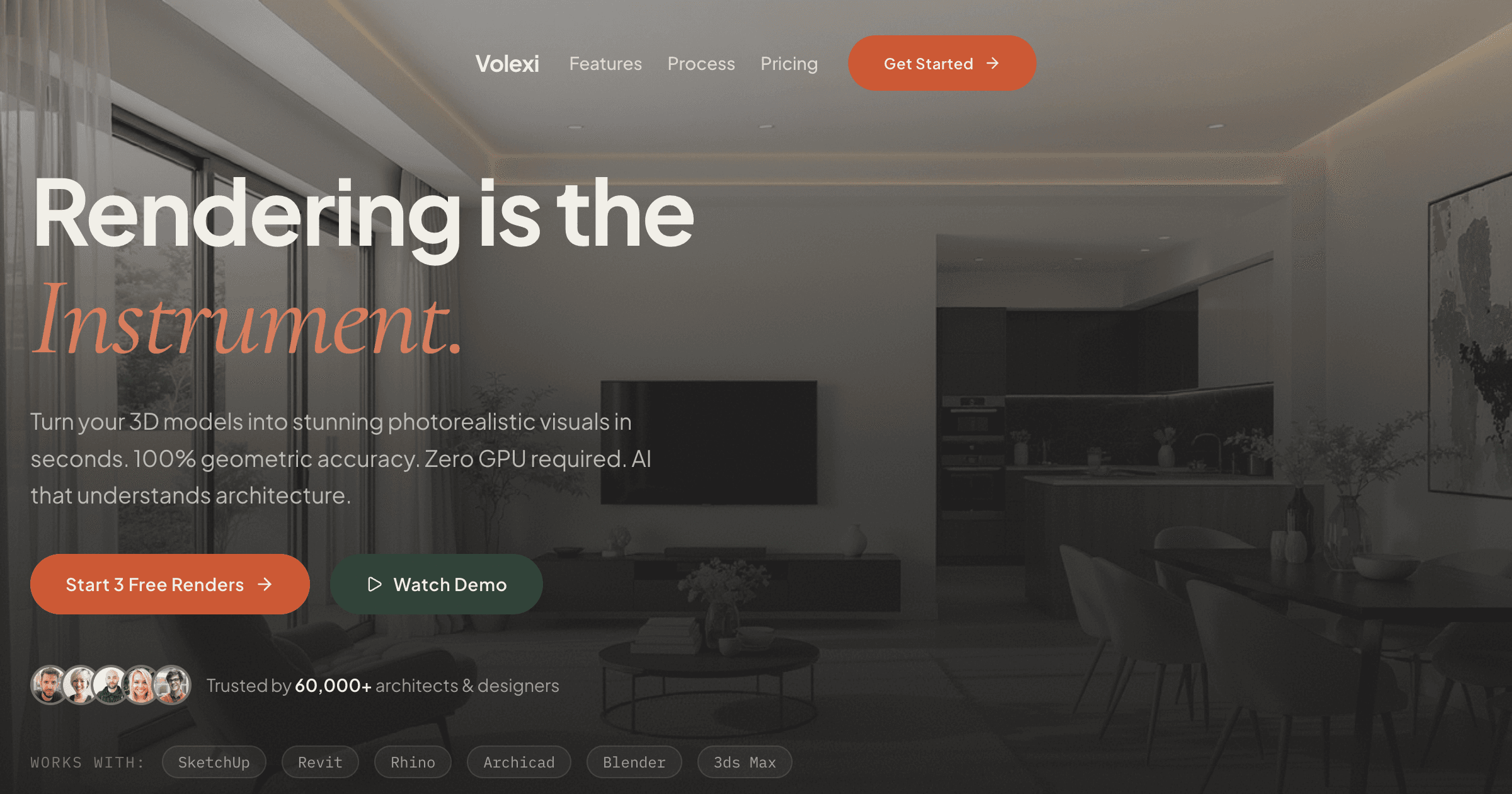
The right Corona renderer alternative depends on which deliverable is hurting: for final print-resolution hero images, Chaos Corona remains hard to beat and probably should not be replaced; for concept iteration and client rounds, an AI option like Volexi turns a viewport screenshot into a presentable render in roughly 30-60 seconds with no render farm involved. Between those poles sit V-Ray with its GPU mode, the real-time engines (Lumion, Twinmotion, D5 Render), and Enscape for design-stage visualization inside CAD.
Corona earned its reputation honestly. It produces some of the most convincing interior light in the industry, its material workflow in 3ds Max and Cinema 4D is mature, and its progressive preview makes look-development pleasant. The cost is time and hardware: Corona is a CPU path tracer, so every frame is paid for in core-hours, and every deadline is negotiated with a render queue. This guide sorts the alternatives by the job they actually solve rather than pretending one tool replaces Corona everywhere.
Why do archviz teams go looking for Corona renderer alternatives?
Teams rarely leave Corona over image quality; they leave over turnaround, because CPU path tracing commonly needs 20-90 minutes per frame for a clean 4K interior, and over hardware, because keeping that tolerable means multi-thousand-dollar many-core workstations or a farm.
The friction shows up in predictable places. Client revision rounds are the worst: a request to try three sofa fabrics and two wall colors is trivial to set up but expensive to render, because each variation re-pays the full frame cost. Concept-stage work suffers for the same reason, since early massing and mood images do not need Corona-grade accuracy but still queue behind it.
- Render time: clean 4K interiors on a 16-core machine routinely take 20-90 minutes per frame in CPU path tracers of Corona-class quality; animations multiply that by frame count.
- Hardware cost: a Threadripper-class workstation built for CPU rendering runs $3,000-6,000, and a small internal farm multiplies that per node.
- Host lock-in: Corona lives inside 3ds Max and Cinema 4D, so SketchUp, Revit, and Rhino users need an export bridge before they can even start.
- Iteration ceiling: the interactive preview is good, but a final-quality check of any change still costs a full render.
None of these are defects; they are the price of an offline path tracer doing its job. The question is whether every image in your pipeline needs to pay that price.
Who gets the most value from staying on Chaos Corona?
Stay on Corona for final marketing images, print-resolution hero shots, and any deliverable where the client signs off on exact materials, because no alternative in this list matches its combination of physically accurate light transport and total per-material control.
This deserves to be said plainly, since alternative roundups tend to bury it. If your studio sells large-format photorealism to developers and brands, Corona is the product. Its layered materials, LightMix for post-render lighting adjustments, and predictable convergence are exactly what that work requires, and an AI renderer cannot promise a specific fabric SKU will appear pixel-accurately in the output.
- Keep Corona when the deliverable is a print-resolution hero image, a marketing campaign set, or anything with contractual material accuracy.
- Keep Corona when your team is already fluent in 3ds Max or Cinema 4D and render time is absorbed by an existing farm.
- Reconsider when most output is concept boards, option studies, and revision rounds where speed matters more than exactness.
- Reconsider when hardware refresh budgets, not artist time, have become the bottleneck on how much you can render.
The realistic outcome for most practices is not replacement but triage: Corona keeps the hero shots, and something faster absorbs the other 80% of images. The rendering software comparison maps that split across the full tool landscape if you want the wider view before drilling into individual options.
How much time does an AI option like Volexi actually recover?
Volexi takes a viewport screenshot from any CAD tool and returns a rendered image in roughly 30-60 seconds at $0.16-0.39 per render, which replaces the scene-preparation and queue time that dominates Corona workflows during concept and revision stages.
The mechanism is image-to-image generation rather than light simulation. You export what is on screen, upload it, describe the mood or materials, and the AI produces a photographic interpretation that keeps your geometry and camera. There is no material assignment, no lighting rig, no farm, and no GPU or CPU requirement on your side, because the compute runs in the cloud and the whole thing works from a browser. For a Corona user the mental shift is that the screenshot replaces the scene: whatever host application produced the view, the AI treats it the same way, which also makes it the rare option in this list that can be trialled on existing hardware for $5.
The arithmetic makes the gap tangible: a 24-image interior option study (four schemes, six angles) queued at a conservative 35 minutes per frame represents about 14 hours of machine time on a Corona-class CPU engine. The same 24 variations at Volexi’s typical 30-60 second turnaround represent under half an hour of wall-clock time, with room for prompt adjustments between batches — and that turnaround holds in production: 96% of Volexi renders over the last 90 days completed successfully. That is a two-order-of-magnitude difference on exactly the kind of disposable imagery that clogs render queues.
The honest caveat cuts the other way. AI output is an interpretation, not a simulation: it will not reproduce a specified fabric or verify how daylight behaves in a physically exact sense, and resolution tops out below large-format print needs. That is why the framing here is triage, not replacement. The AI architectural rendering guide covers where the approach holds up and where it does not in more depth.
Is switching to V-Ray really a switch at all?
V-Ray is the lowest-friction Corona alternative because both are Chaos products sharing a material-conversion path, and its GPU and hybrid rendering modes can cut frame times substantially on RTX hardware while keeping offline-quality output.
For a studio whose complaint is purely render time, V-Ray deserves the first look. Scene logic, host applications, and much of the material thinking carry over, and Chaos ships converters between the two engines. GPU mode shifts the cost from core-hours to graphics cards, which is a better trade for some studios and a worse one for others: a capable RTX card accelerates every artist seat, but now every seat needs one, and heavy interiors can exceed GPU memory in ways CPU rendering never does.
V-Ray is also more complex than Corona by design. Part of the reason Corona has such loyal users is that it removed most of the knobs V-Ray exposes, so migrating means re-accepting configuration depth that Corona deliberately hid. If the evaluation widens beyond the Chaos family entirely, the V-Ray alternative breakdown applies almost verbatim to Corona users, since both engines occupy the same offline-quality position in a pipeline.
What do Lumion, Twinmotion, and D5 trade away for their speed?
Real-time engines render frames in milliseconds and add navigation, animation, and weather systems, but they trade Corona-grade light accuracy and material subtlety for that speed, and they demand a serious RTX-class GPU where Corona demanded CPU cores.
This family answers a different question than Corona does. If clients want to walk the space, scrub the sun across the sky, or receive an animated flythrough without an overnight render, Lumion, Twinmotion, and D5 Render are built for precisely that. Their still-image output has improved sharply, and for exteriors at web resolution many clients cannot tell the difference. Interiors remain the gap: soft indirect light, contact shadows, and glossy material response are where trained eyes still separate real-time output from a converged path trace.
- Lumion: the fastest route from model to polished exterior with a huge asset library; Windows-only and GPU-hungry.
- Twinmotion: Unreal-based, runs on Mac and Windows, strong Datasmith links into Revit and Archicad; a path toward full Unreal Engine work.
- D5 Render: ray-traced real-time output that gets closest to offline stills, but requires an NVIDIA RTX card and Windows.
Animation economics are where this family genuinely beats Corona rather than merely approximating it. A 30-second flythrough at 30 frames per second is 900 frames; at even 20 minutes per frame that is 300 hours of CPU time in an offline engine, versus minutes of export in a real-time one. Studios that sell moving imagery usually keep a real-time engine in the stack for that reason alone, whatever they choose for stills.
Note that the hardware bill does not disappear with these tools; it moves. A studio leaving Corona to escape workstation costs will find real-time engines reintroduce them as GPU line items, which is exactly the cost a browser-based option avoids.
Where does Enscape fit for a practice raised on Corona?
Enscape suits the design-development phase rather than the final-image phase: it renders live inside Revit, SketchUp, Rhino, Archicad, and Vectorworks, so the model is always the scene, but its output sits a clear step below Corona for polished marketing stills.
Enscape and Corona barely compete, which is what makes them a common pairing. Enscape lives inside the authoring tool and updates as the design changes, making it ideal for internal design review, client work-in-progress meetings, and quick VR walkthroughs. Since Enscape and Corona are both Chaos products, the vendor itself positions them as stages of one pipeline: Enscape while designing, an offline engine for finals. For a Corona user, adopting Enscape changes nothing about the final-image workflow; it removes the temptation to burn Corona render hours on images that only needed to be good enough for a Tuesday meeting.
The limits are the same as the real-time family: GPU requirements on every seat that runs it, and a rendered look that reads as competent rather than photographic on interior stills. Studios that need design-stage speed without per-seat GPU spend often find the browser-based AI route covers the same meeting-imagery job from a plain laptop.
Which alternative should handle which deliverable in practice?
Assign tools by output: Corona keeps print-resolution heroes and material-exact finals, Volexi takes concept images and client revision rounds, V-Ray GPU covers offline quality on shorter timelines, and a real-time engine or Enscape handles walkthroughs and live design review.
- Final marketing and print heroes: Corona, unchanged. This is the work it exists for.
- Concept boards and option studies: Volexi, because a 30-60 second turnaround at $0.16-0.39 per image makes exploring ten directions cheaper than rendering one.
- Client revision rounds: Volexi for look-and-feel changes; Corona only once the option is chosen and must be exact.
- Offline quality on a deadline: V-Ray with GPU or hybrid rendering, staying inside the Chaos ecosystem.
- Walkthroughs, animation, VR: Twinmotion or D5 Render for output quality, Lumion for speed of assembly, Enscape when it must live inside the CAD tool.
The cheapest way to test the fast half of this split is to take a screenshot of whatever is in your viewport right now and run it through the $5 Volexi Intro pack before touching budgets or IT. If the output is good enough for tomorrow morning's client call, you have found the queue relief; if it is not, you have spent a few minutes learning that Corona should keep that job too.
Corona and Chaos Corona are trademarks of Chaos Software, and V-Ray and Enscape are Chaos products. Volexi is an independent tool and is not affiliated with, sponsored by, or endorsed by Chaos Software or any other vendor mentioned here.
Compare the full rendering landscape
See how Corona, V-Ray, the real-time engines, and AI rendering stack up across price, hardware, and output quality in the complete comparison.